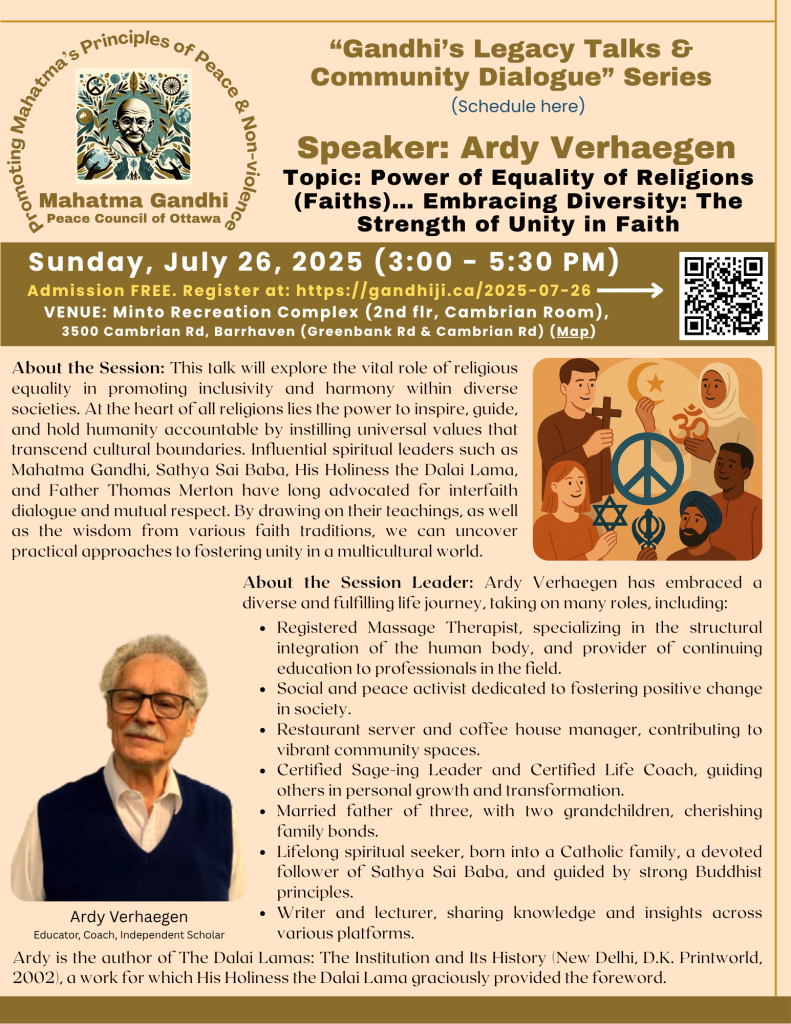
Event Date & Time: Saturday, July 26, 2025 (3:00-5:30 pm)
For information, contact: Anil Agrawal (613-859-8654)
Ardy Verhaegen's Talk
Brief Summary by ChatTube AI:
In his talk, Ardy Verhaegen discusses the concept of equality among religions, highlighting Mahatma Gandhi’s belief in the shared values and ethical principles found in various faith traditions. He emphasizes the importance of promoting interfaith harmony and mutual respect, focusing on spiritual growth rather than the superiority of one religion over another. Verhaegen advocates for a global consciousness that recognizes the commonalities among religions, thereby fostering peace rather than conflict.
Ardy Verhaegen - Community Dialogue
Brief Summary by ChatTube AI:
The community dialogue video delves into the complexity of religion and its impact on humanity, highlighting the importance of both individual and collective consciousness in promoting peace. A key metaphor is introduced, relating to the idea of feeding one’s inner ‘wolf’ that represents love and positivity versus aggression and violence. The speaker emphasizes that while religions have been used to justify violence, they also share fundamental values that can unite people in seeking harmony and understanding.
The video titled “Power of Equality of Religions (Faiths)” features a talk by Ardy Verhaegen discussing the principles held by Mahatma Gandhi regarding the equality of religions. Verhaegen addresses the contemporary issues of intolerance and conflict between religious and cultural groups globally and emphasizes the importance of recognizing common values among different faith traditions.
In his discourse, Verhaegen references the universal principle of the Golden Rule, which emphasizes treating others as one wishes to be treated. This principle is echoed across major religions, including Hinduism, Buddhism, Judaism, Islam, Christianity, and Zoroastrianism, highlighting the foundational ethical teachings found in these diverse faiths.
Verhaegen draws on the writings of noted scholar Houston Smith, who describes various viewpoints on the relationship between religions, ranging from the notion that one religion is superior to others, to the perspective that all religions are fundamentally alike, and finally, to an acknowledgment of differences without assigning worth. He emphasizes that common ethical values, virtues like humility, charity, and truth, as well as a shared vision for humanity, are present in all major religions. This shared understanding encourages a shift toward a more peaceful coexistence rather than one driven by conflict and dogma.
The speaker illustrates how Gandhi’s commitment to Sarv Dharma Samanatva—the principle of equality among religions—can foster interfaith harmony. He recounts Gandhi’s view that each religion holds some truth while also possessing some errors, advocating for practitioners to deepen their understanding and practice of their respective faiths rather than attempt conversion.
Verhaegen discusses his spiritual journey and experiences with various religions, including interactions with spiritual leaders and involvement in interfaith initiatives, such as youth engagement projects and dialogues aimed at promoting unity among diverse faith traditions. He highlights significant initiatives, such as the Parliament of World Religions and various interfaith youth programs, underscoring the ongoing efforts to cultivate respect and understanding across cultural and religious lines.
The talk culminates in a call to action, encouraging individuals to embody the principles of unity and equality in their daily lives, as Gandhi famously said, “Be the change that you wish to see in the world.” Verhaegen’s perspective fosters a vision of peace through collective and individual action, emphasizing the essential oneness that connects all human beings, regardless of their diverse beliefs.
Understanding diversity can significantly enhance community relationships in several ways:
- **Fostering Respect and Tolerance**: When individuals acknowledge and appreciate the diverse backgrounds and perspectives within their community, it cultivates a sense of respect and tolerance. This understanding can help mitigate misunderstandings and reduce the likelihood of conflict arising from cultural differences.
- **Building Stronger Connections**: Diversity brings a variety of experiences, ideas, and viewpoints to the table. By embracing these differences, community members can form deeper connections based on mutual respect and shared interests, leading to more robust and supportive relationships.
- **Encouraging Collaboration**: Understanding the diverse strengths and resources of various community groups can promote collaboration on initiatives and projects. Working together allows individuals to leverage each other’s strengths, fostering a sense of unity and shared purpose.
- **Enhancing Creativity and Innovation**: A diverse community is often a more innovative one. Different perspectives can lead to creative solutions and new ideas, enriching the community’s cultural and intellectual landscape.
- **Promoting Social Cohesion**: When individuals recognize the value of diversity, they are more likely to engage in inclusive practices, which can lead to increased social cohesion. A strong, united community is more resilient in facing challenges together.
- **Empowering Marginalized Voices**: Understanding diversity allows communities to give a platform to voices that may have been marginalized or overlooked. Empowering these voices leads to a more representative community where everyone feels valued and heard.
- **Facilitating Intercultural Dialogue**: Engaging in conversations that explore diverse perspectives enhances understanding. Such dialogue can break down stereotypes and foster empathy, leading to a more harmonious community environment.
- **Encouraging Community Engagement**: When community members feel understood and respected, they are more likely to engage in local initiatives and contribute positively to the community. This engagement strengthens the social fabric of the community.
By embracing and understanding diversity, communities can build more enriching relationships that celebrate differences while uniting individuals towards common goals.
Practicing tolerance towards different religions in daily life can be approached through various actions and attitudes. Here are some ways individuals can do this:
- **Educate Yourself**: Take the time to learn about different religions, their beliefs, practices, and values. Understanding the fundamentals of other faiths can foster respect and reduce misconceptions.
- **Engage in Open Dialogue**: Encourage conversations with people of different religions. Listen actively and ask respectful questions to gain insight into their beliefs and perspectives.
- **Attend Interfaith Events**: Participate in interfaith dialogues, workshops, or community events that bring together individuals from various religious backgrounds. These gatherings can promote understanding and collaboration.
- **Be Respectful of Practices**: Show respect for the religious practices of others, whether it’s observing dietary restrictions, accommodating prayer times, or respecting sacred spaces. Acknowledging these practices demonstrates consideration and respect.
- **Challenge Stereotypes**: Avoid making assumptions or generalizations about individuals based on their religion. Challenge any prejudiced views you may encounter and encourage others to do the same.
- **Promote Inclusivity**: Advocate for inclusive practices in your community, workplace, or social settings. Support policies and initiatives that embrace diversity and respect for all faiths.
- **Practice Empathy**: Try to put yourself in others’ shoes. Understanding their experiences and feelings can help cultivate compassion, even in moments of disagreement.
- **Model Kindness and Acceptance**: Demonstrate kindness and acceptance in your interactions with others. Small gestures of friendship and understanding go a long way in fostering a tolerant environment.
- **Reflect on Your Own Beliefs**: Take time to reflect on your own beliefs and how they relate to those of others. Understanding your values can help you appreciate and tolerate different viewpoints.
- **Support Religious Freedom**: Advocate for the right to practice one’s religion without fear of discrimination or persecution. Show solidarity with those whose beliefs may be marginalized.
- **Promote Peaceful Coexistence**: Engage in activities that promote peaceful coexistence among people of different religions, such as community service projects that unite diverse groups for a common cause.
By actively engaging in these practices, individuals can contribute to a more tolerant and harmonious society where diverse religious beliefs are respected and celebrated.
Interfaith dialogue plays a crucial role in contributing to global peace efforts in several significant ways:
- **Promoting Understanding and Respect**: Interfaith dialogue encourages individuals from different religious backgrounds to engage in meaningful conversations. This process fosters understanding and respect for diverse beliefs, reducing misunderstandings and potential conflicts.
- **Building Relationships**: By facilitating interactions between people of different faiths, interfaith dialogue helps foster relationships founded on trust and mutual respect. Stronger connections between communities create an atmosphere of cooperation and collaboration.
- **Addressing Misconceptions**: Open discussions allow participants to address misconceptions and stereotypes about different religions. Clarifying these misunderstandings helps to reduce prejudice and fear, which are often at the root of conflict.
- **Encouraging Shared Values**: Many religious traditions share core values such as compassion, justice, peace, and the dignity of all human beings. Interfaith dialogue highlights these commonalities, promoting unity and a shared commitment to global peace.
- **Conflict Resolution**: Engaging in interfaith dialogue can provide a platform for addressing specific conflicts related to religion. Dialogue can facilitate negotiations, encouraging understanding and collaboration in resolving disputes in a peaceful manner.
- **Fostering a Culture of Peace**: By promoting dialogue, communities can cultivate a culture of peace that emphasizes coexistence, tolerance, and respect for differences. This cultural shift can lead to long-term stability and harmony.
- **Empowering Diverse Voices**: Interfaith dialogue provides a platform for marginalized voices to be heard. By empowering individuals from various faiths, these discussions can address social injustices and promote equality, contributing to a more peaceful society.
- **Mobilizing Collective Action**: Interfaith initiatives can unite diverse religious communities around shared goals, such as humanitarian efforts, environmental sustainability, or social justice. Collective action amplifies the impact of peace efforts and demonstrates a sense of solidarity.
- **Promoting Global Citizenship**: By recognizing shared humanity and interconnectedness through interfaith dialogue, participants are encouraged to act as global citizens. This mindset fosters a commitment to collaboratively addressing global issues.
- **Educating Future Generations**: Interfaith dialogue can include educational components that instill values of tolerance, respect, and understanding in younger generations. This education can help shape future leaders who prioritize peace and coexistence.
By emphasizing communication, collaboration, and respect, interfaith dialogue is a powerful tool for fostering understanding and goodwill among different cultures and religions, ultimately contributing to global peace efforts.
In the community dialogue titled “Equality of Religions (Faiths)” led by Ardy Verhaegen, various important themes concerning the role of religion in society and the potential for achieving peace and understanding among different faiths are discussed.
### Key Themes and Summary:
1. **Violence in the Name of Religion**:
– Ardy acknowledges the concern that religion can lead to violence, noting how factions and societies sometimes exploit faith to justify aggression. He emphasizes the dual nature of humanity, where both negative and positive traits co-exist and urges individuals to reflect on which side they choose to nurture.
2. **The Grandfather and the Two Wolves**:
– Ardy shares a parable about a grandfather teaching his grandchild about the two wolves within us—the wolf of destruction and the wolf of support. The message is clear: the one that ‘wins’ is the one we choose to feed, highlighting personal responsibility in promoting peace and love.
3. **Evolution of Human Consciousness**:
– He discusses the evolution of consciousness, referencing Ken Wilbur’s work on the journey from animal consciousness to divine consciousness. This evolution reflects humanity’s growing awareness and capacity for self-reflection, thereby encouraging individuals to act as instruments of peace.
4. **Principles of “Do No Harm”**:
– A fundamental principle Ardy advocates is “do no harm.” He believes that recognizing what harm is and consciously choosing not to inflict it can guide interactions with others.
5. **Interfaith Dialogue and Unity in Diversity**:
– A participant shares how their background aligns with the teachings of the Bahá’í Faith, particularly its emphasis on unity in diversity. The conversation explores how societal development—especially technology—has brought people together, potentially fostering a greater understanding among diverse faiths.
6. **Deep Exploration of Faith**:
– Ardy argues for a deeper understanding of religions, suggesting that when one delves into the core teachings of any faith, common values emerge across different belief systems. He encourages individuals to explore the transcendental aspects of their religions to find shared ground.
7. **Addressing Extremism**:
– During the dialogue, concerns about extremism within religions, particularly Islam, are raised. Ardy counters that while fundamentalism exists, it does not represent the majority of adherents. He points to the peaceful essence found in the writings of many religious traditions, including Sufi teachings in Islam.
8. **Activism and Personal Responsibility**:
– Ardy underscores the importance of personal action in addressing societal issues. Citing his past activism, he emphasizes that while broader political change is important, individuals can also contribute by fostering understanding and building connections within their communities.
9. **Bringing Light to the World**:
– Concluding the dialogue, Ardy quotes a sentiment attributed to the Buddha, advocating for individuals to “light up your corner of the world.” He encourages everyone to model peace, love, and understanding in their daily interactions.
Through this dialogue, participants are urged to reflect, engage with others across different faiths, and promote a message of peace and acceptance in a world that often seems divided. The conversation emphasizes the potential for unity in beliefs and the shared responsibility individuals have in creating a harmonious society.
.
Individual actions can play a significant role in promoting community understanding and acceptance in several ways:
1. **Modeling Behavior**:
– When individuals demonstrate openness and respect towards diverse beliefs and practices, they set an example for others. Simple acts of kindness, patience, and understanding can inspire those around them to adopt similar attitudes.
2. **Engaging in Dialogue**:
– Initiating conversations with people from different backgrounds fosters understanding. Sharing personal stories, experiences, and perspectives encourages mutual respect and empathy. This dialogue can dispel stereotypes and misconceptions about different faiths or cultures.
3. **Participating in Community Events**:
– Attending or organizing events that celebrate cultural diversity—such as interfaith gatherings, multicultural festivals, or community dialogues—can break down barriers. These shared experiences can highlight common values and strengthen bonds among community members.
4. **Volunteering**:
– Participating in community service projects helps build a sense of belonging and shared purpose. Working alongside people of different backgrounds can create opportunities for meaningful interactions and collaboration, fostering a spirit of unity.
5. **Educating Oneself and Others**:
– Taking the initiative to learn about other cultures and religions can broaden one’s perspective. Sharing this knowledge with others through discussions, workshops, or educational programs can help reduce ignorance and promote acceptance.
6. **Advocating for Inclusivity**:
– Individuals can advocate for policies and practices within their communities that promote inclusivity and respect for diversity. This might include supporting local initiatives that address discrimination, promoting equitable representation, or pushing for community resources that reflect various cultural needs.
7. **Being an Ally**:
– Standing up for and supporting marginalized groups within the community demonstrates solidarity and commitment to acceptance. This can involve speaking out against discrimination, amplifying the voices of others, and being present in moments of need.
8. **Practicing Active Listening**:
– Engaging in active listening during conversations helps to validate others’ experiences and feelings. This approach fosters trust and encourages open, honest communication, which is essential for understanding.
9. **Promoting Common Values**:
– Highlighting shared values, such as compassion, love, and the desire for peace, can underscore the commonality among diverse groups. Focusing on what unites rather than divides can pave the way for greater acceptance.
10. **Creating Inclusive Spaces**:
– Individuals can work towards creating spaces—be it in workplaces, schools, or community centers—that are welcoming to all. This might involve facilitating dialogues, providing resources, or ensuring representation of different perspectives in decision-making.
By taking these actions, individuals can contribute to a culture of understanding and acceptance within their communities, creating a more harmonious and cohesive society.
Addressing fundamentalism within various faiths requires a multi-faceted approach that focuses on understanding, education, dialogue, and community engagement. Here are some strategies to consider:
1. **Promote Interfaith Dialogue**:
– Encourage open conversations between different faith groups to foster mutual understanding. These dialogues can help dispel misconceptions, reduce hostility, and promote respect among diverse beliefs.
2. **Educate on Core Teachings**:
– Providing education about the fundamental teachings of various religions can help individuals understand the broader context of their beliefs. Emphasizing interpretations that promote peace, compassion, and understanding can counteract extremist views.
3. **Encourage Critical Thinking**:
– Promote critical examination of religious texts and teachings. Encouraging followers to engage with their faith in a reflective manner can help them discern between fundamentalist interpretations and those that promote harmony and understanding.
4. **Highlight Positive Examples**:
– Showcase and support leaders and figures within various faiths who advocate for peace, tolerance, and interfaith cooperation. These role models can inspire others to adopt more moderate viewpoints and engage constructively with others.
5. **Create Safe Spaces for Exploration**:
– Establish forums, workshops, and community groups where individuals can explore their faith without fear of judgment. These spaces can encourage open discussion about doubts, questions, and the diverse interpretations of beliefs.
6. **Support Community Initiatives**:
– Engage with community programs that promote inclusivity and understanding. Initiatives that address social issues collaboratively can bridge divides and demonstrate common goals among different faiths.
7. **Address Socioeconomic Factors**:
– Recognize that fundamentalism can often be fueled by socioeconomic disparities and a lack of opportunities. Addressing issues such as poverty, education, and social justice can reduce the appeal of extremist ideologies.
8. **Foster Resilience Against Extremism**:
– Support programs that teach conflict resolution, emotional intelligence, and resilience, particularly among youth. Empowering young people with tools to navigate differences can reduce susceptibility to radicalization.
9. **Promote Peacebuilding Efforts**:
– Encourage and engage in interfaith peacebuilding initiatives. Collaborating on community service projects and advocacy for justice can strengthen bonds and emphasize shared values.
10. **Encourage Open Messaging from Religious Leaders**:
– Urge religious leaders to speak out against extremism and promote inclusivity through sermons, teachings, and community activities. Their influence can be pivotal in shaping perceptions within their congregations.
11. **Utilize Social Media Effectively**:
– Leverage digital platforms to disseminate positive narratives about faith and community engagement. Campaigns that promote understanding and tolerance can reach wider audiences and counteract extremist propaganda.
12. **Challenge Extremist Narratives**:
– Actively counteract harmful narratives by exposing their flaws and emphasizing the diversity of interpretations within a faith. Providing alternative narratives that highlight peace and coexistence can displace fundamentalist viewpoints.
By implementing these strategies within communities, we can work towards a more nuanced understanding of faith that recognizes diversity, promotes acceptance, and ultimately diminishes the hold of fundamentalism across various religions.
Promoting peace in diverse communities requires intentional actions and strategies that foster understanding, acceptance, and collaboration among different groups. Here are several effective strategies:
1. **Facilitate Intercultural Dialogue**:
– Organize forums, workshops, and discussion groups where community members can share their traditions, beliefs, and experiences. Open dialogue encourages mutual respect and appreciation for diversity.
2. **Establish Community Alliances**:
– Create partnerships among various community groups, organizations, and faith institutions. Collaborative efforts on community projects, events, and social issues can strengthen relationships and build trust.
3. **Promote Inclusivity in Leadership**:
– Ensure that community leadership reflects its diversity. Including representatives from different backgrounds in decision-making processes can foster a sense of belonging and ensure that multiple perspectives are heard.
4. **Implement Conflict Resolution Training**:
– Provide training on conflict resolution and mediation skills for community members, leaders, and organizations. Equipping individuals with tools to handle disputes constructively can prevent escalations and promote understanding.
5. **Celebrate Cultural Diversity**:
– Organize events that celebrate the various cultures within the community, such as festivals, art shows, or food fairs. These celebrations can showcase the richness of diversity and create opportunities for residents to connect.
6. **Offer Educational Programs**:
– Develop educational initiatives that emphasize the importance of tolerance, empathy, and civic responsibility. Curriculum focused on cultural literacy and history can create an informed citizenry that values peaceful coexistence.
7. **Support Youth Engagement**:
– Engage young people in peacebuilding activities through clubs, sports, or community service projects. Youth-led initiatives can foster dialogue and understanding among peers and create lasting connections.
8. **Encourage Active Participation**:
– Encourage residents to be actively involved in local governance and community activities. Higher engagement levels can lead to a greater sense of ownership and responsibility for promoting peace and unity.
9. **Utilize Media Constructively**:
– Use local media platforms to share positive stories about diversity, collaboration, and conflict resolution efforts within the community. Highlighting success stories can inspire others to participate in peace initiatives.
10. **Promote Restorative Justice Practices**:
– Implement restorative justice programs in schools and community organizations to address conflicts and harms. This approach emphasizes healing and reintegration rather than punishment, fostering more harmonious interactions.
11. **Create Safe Spaces for Expression**:
– Establish safe spaces where individuals can express their concerns, feelings, and experiences related to conflict or diversity. Creating environments where people feel heard fosters trust and understanding.
12. **Encourage Community Service**:
– Organize community service projects that require collaboration among diverse groups. Working together to address shared challenges can build camaraderie and reinforce a sense of shared purpose.
13. **Strengthen Local Economic Opportunities**:
– Promote economic initiatives that benefit all community members and create opportunities for collaboration. Economic equity can reduce tensions and foster a sense of shared well-being.
14. **Highlight Shared Values**:
– Focus on common values that unite individuals across different backgrounds, such as compassion, justice, and the desire for a safe environment. Reinforcing shared values can help strengthen community bonds.
By implementing these strategies, diverse communities can cultivate a culture of peace that values cooperation, understanding, and respect, leading to a more harmonious and resilient society.